NEW 2026
Spikeling v3 is now available
Spikeling
A hardware implementation of spiking neurons for neuroscience teaching and outreach
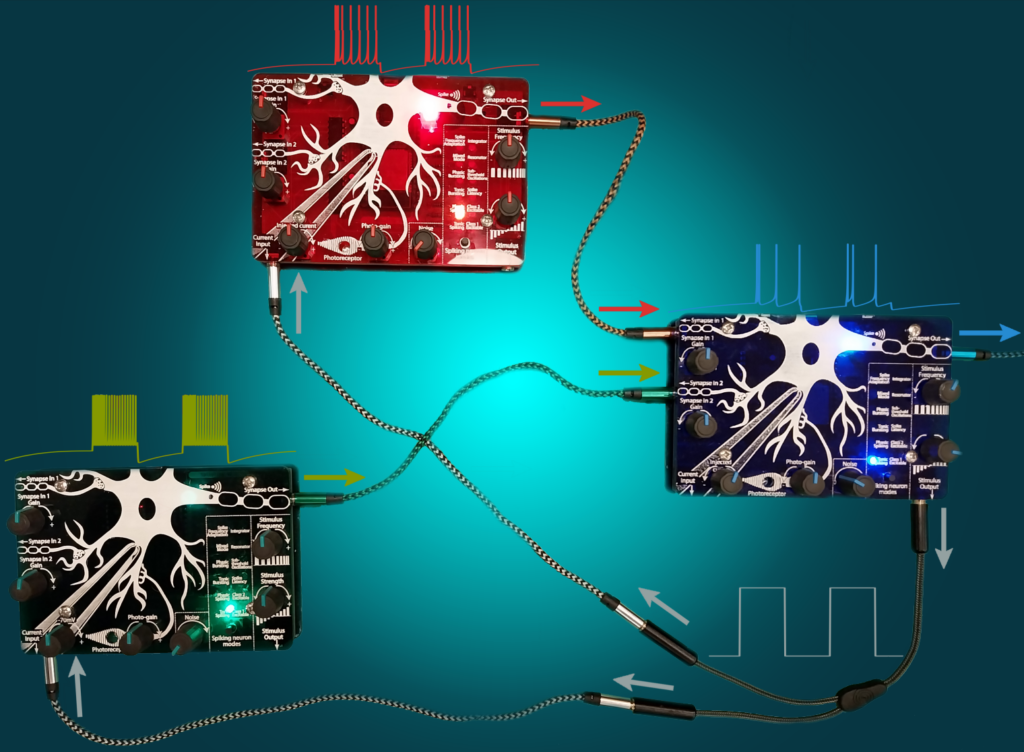
A complete electrophysiology-style setup for the classroom
Bridges theory and experimental practice
Hands-on learning of neural coding and signal processing
Spikeling is an open-source neuroscience education platform designed to make core neurophysiology concepts teachable through hands-on experimentation, even in settings where traditional wet-lab electrophysiology is impractical.
In many degree programs, students learn about action potentials and synaptic signalling largely through lectures or static datasets because living preparations, microscopes, amplifiers, and specialist supervision do not scale well to large cohorts. Spikeling addresses this gap with a low-cost “in silico neuron” implemented in hardware.
The device provides electrophysiology-style interaction: controlled stimulation, measurable membrane-voltage dynamics, spike output, and parameter manipulation to explore firing regimes, adaptation, and input integration.
Get Started
Request Units or a Workshop
We supply units and support classroom deployments, hands-on labs, and outreach sessions.
Download desktop app (GUI)
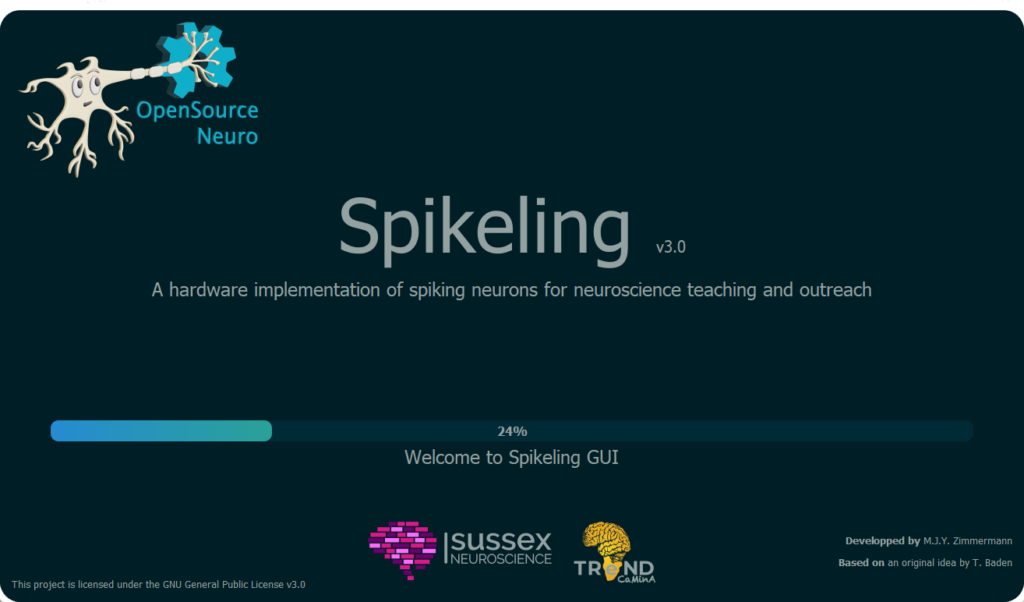
Windows, Linux, and macOS releases. Includes Emulator mode where no hardware is required.
Documentation and Guides
Installation guides, classroom workflows, and full technical documentation.
We share our educational goals here
Spikeling in Academia & Outreach
The spikeling project emerged from local needs to teach neuroscience class modules for direct interaction with neuron physiology, data analysis, fluorescence imaging, protocol design, etc.
The aim was to provide hands-on experience on how neurons encode information and how diverse variables modulates their activities, while engaging students with crucial aspects of data collection, experimental limitations, methodology and statistical analysis.
Spikeling is currently used in university teaching, computational neuroscience training, and outreach events. It is intentionally open (hardware + firmware + software) so educators can customize activities for their courses and contribute back to a shared pool of teaching material.
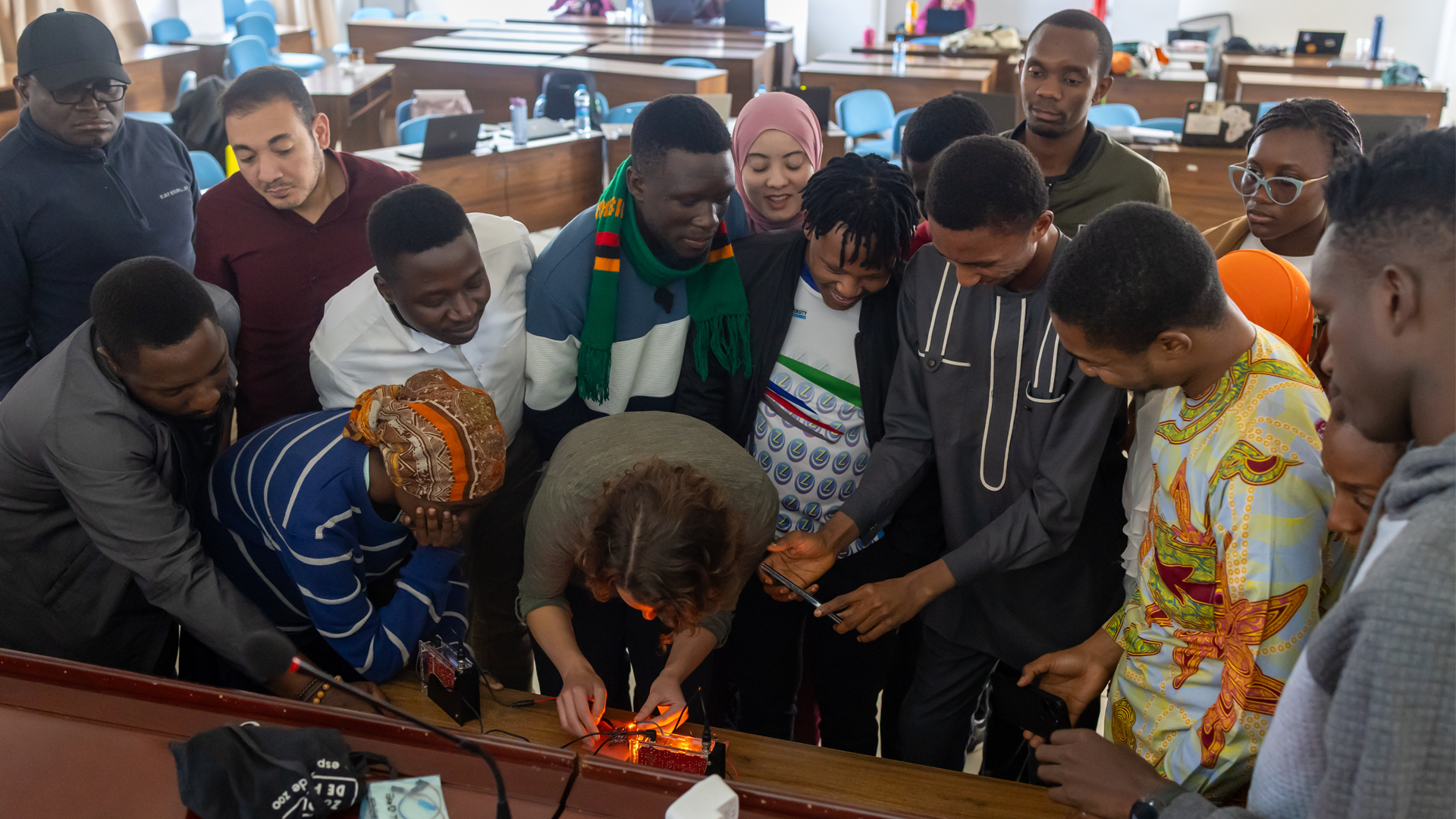
Spikeling workshop Zambia 2025
Always nice to see students enjoying a good Spikeling workshop ! With TReND-CaMinA
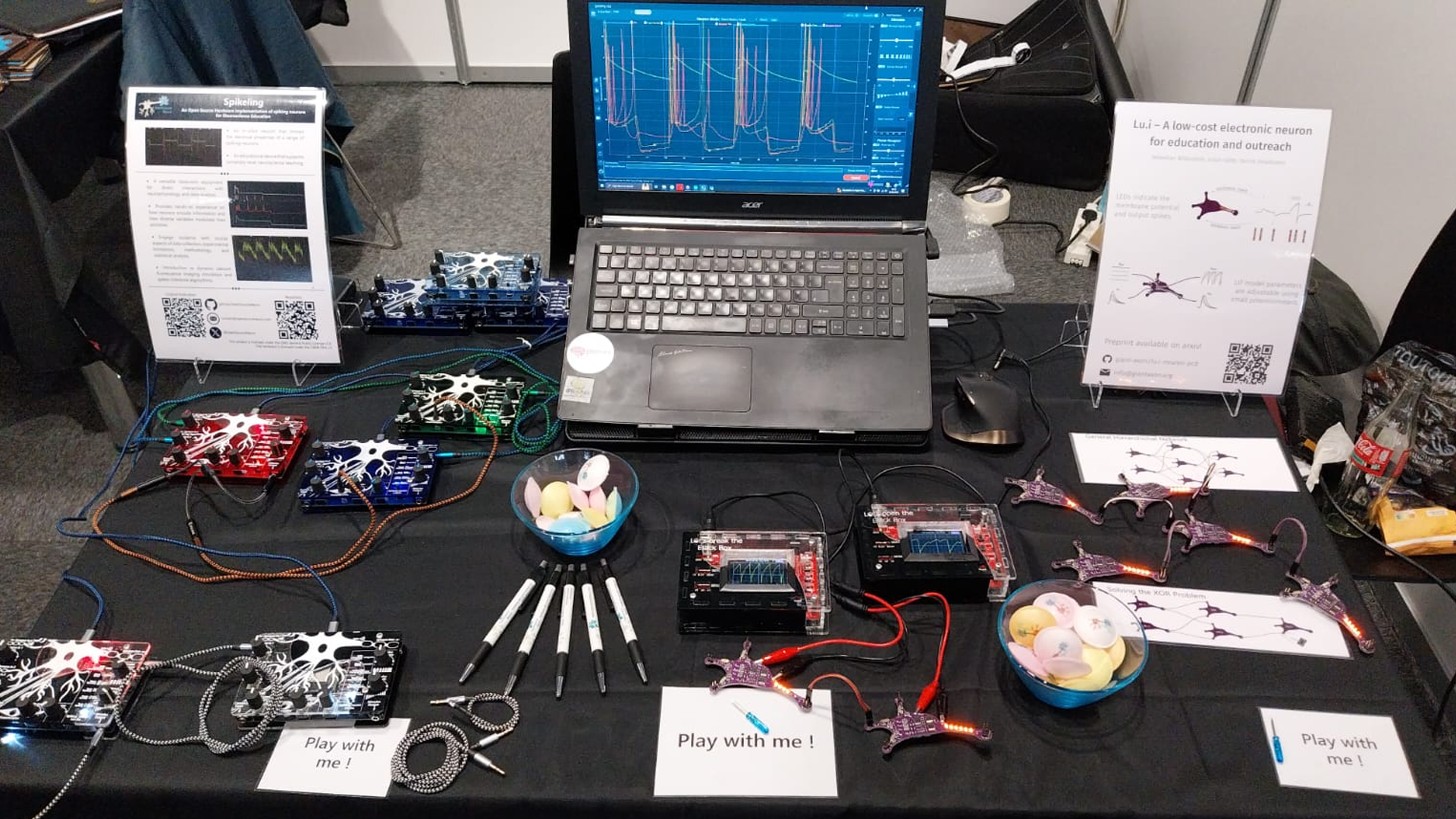
The OSN stand at FENS 2022
Starring Spikeling (left) which spark lots of interest and enthusiastic discussions !
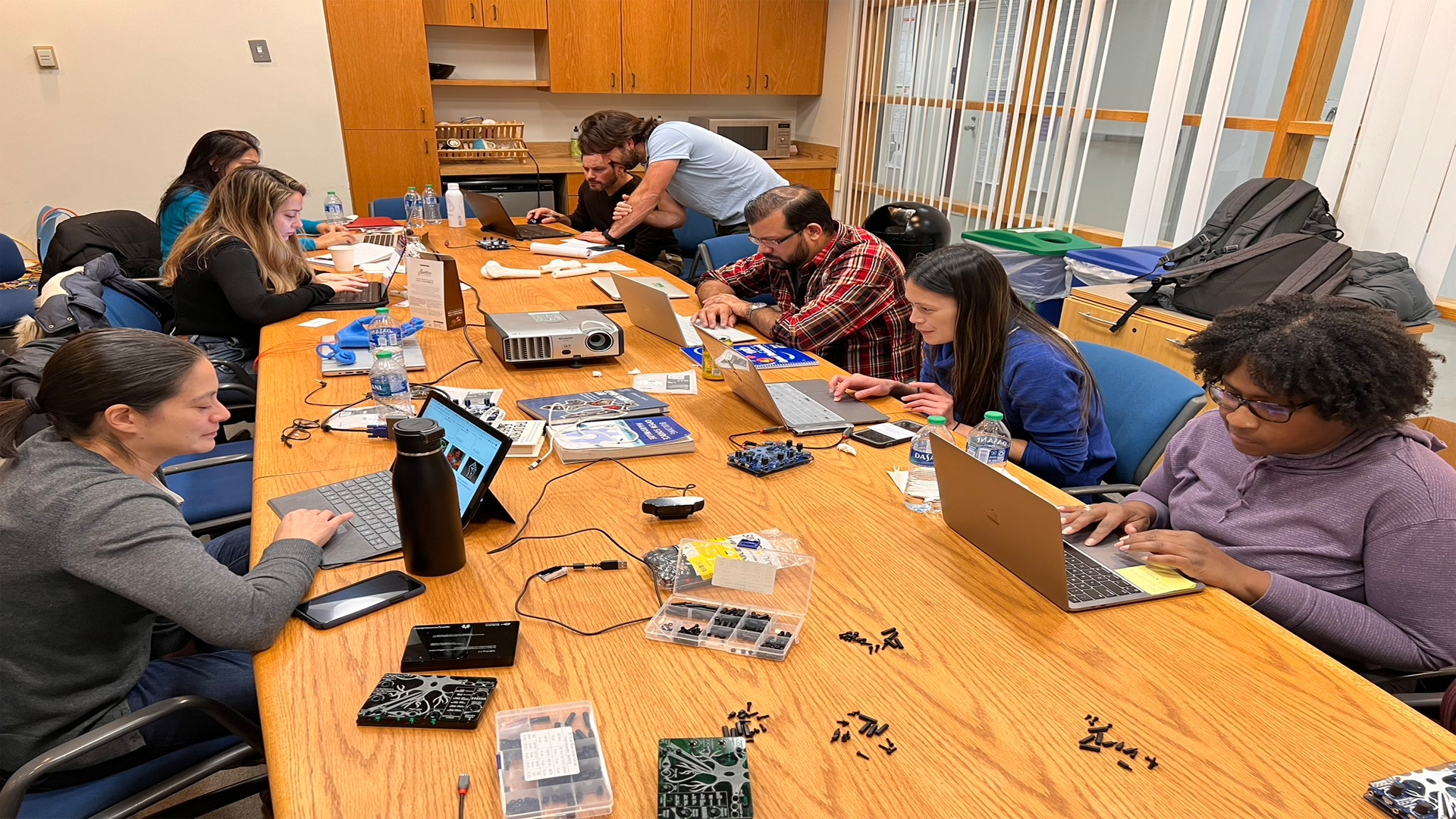
Spikeling workshop in NYC
Students brainstorming on Spikeling exercices...
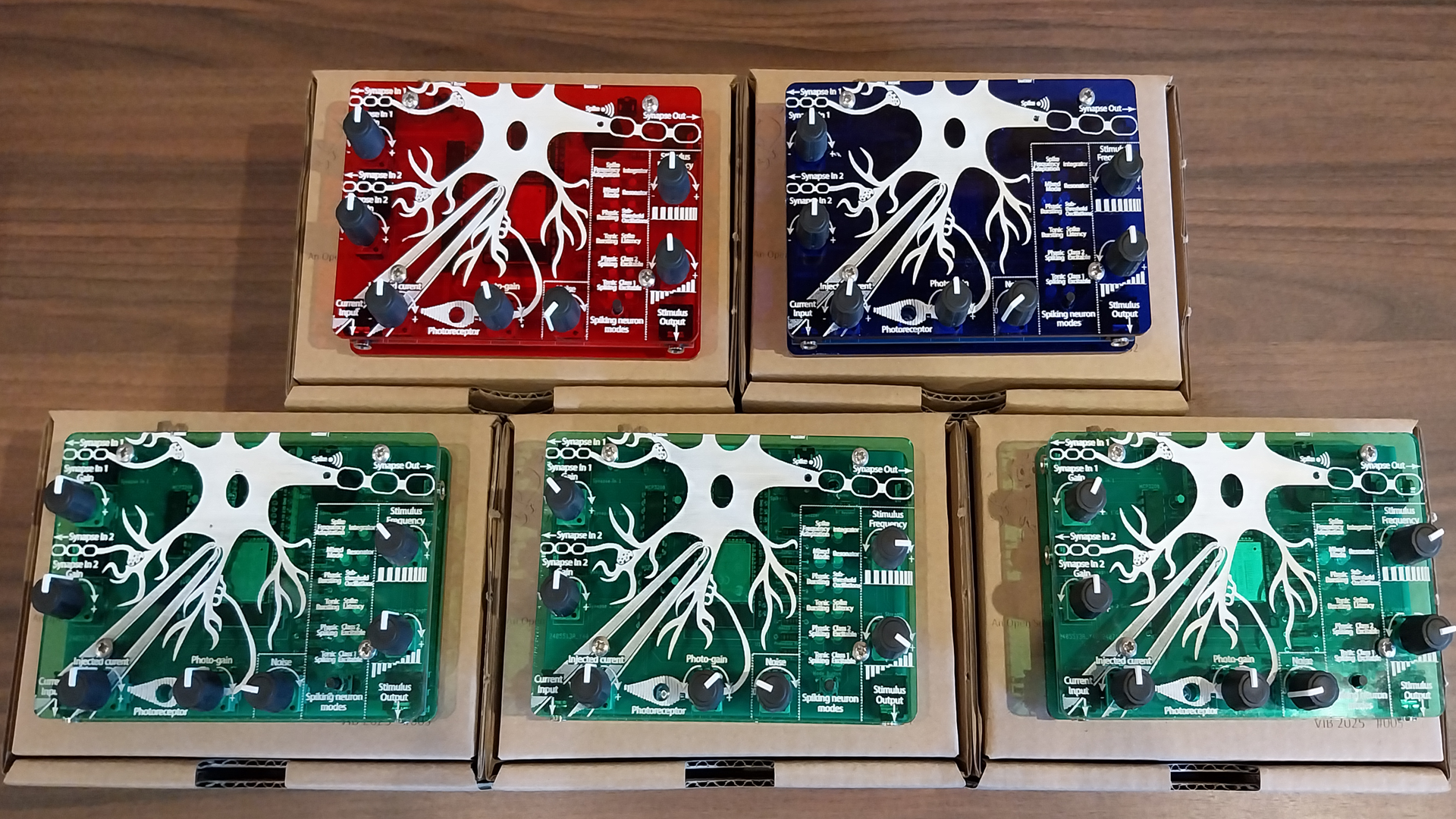
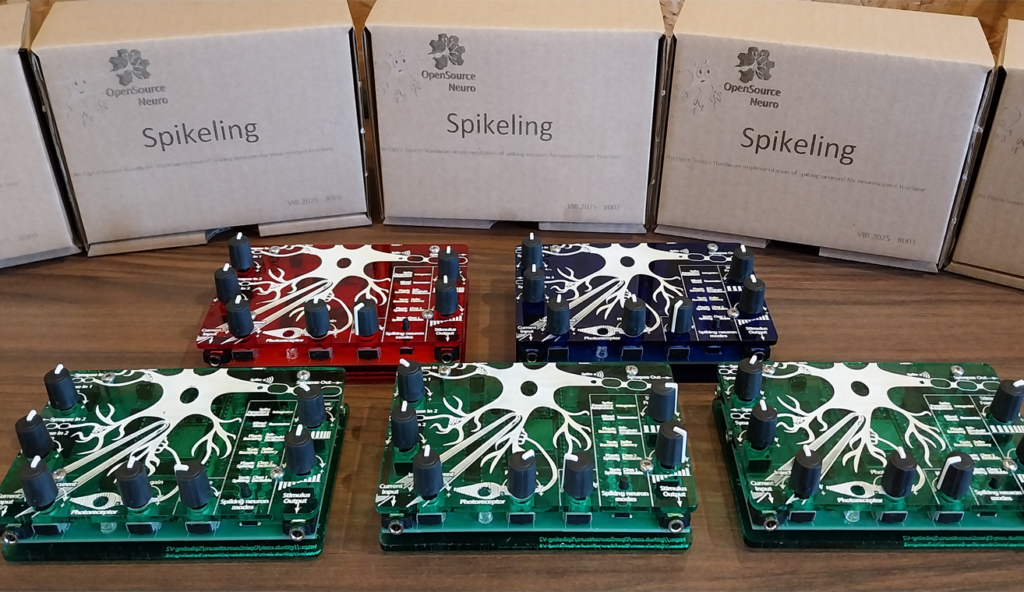
Spikeling Boards
In three different colours, ready to plug and play !
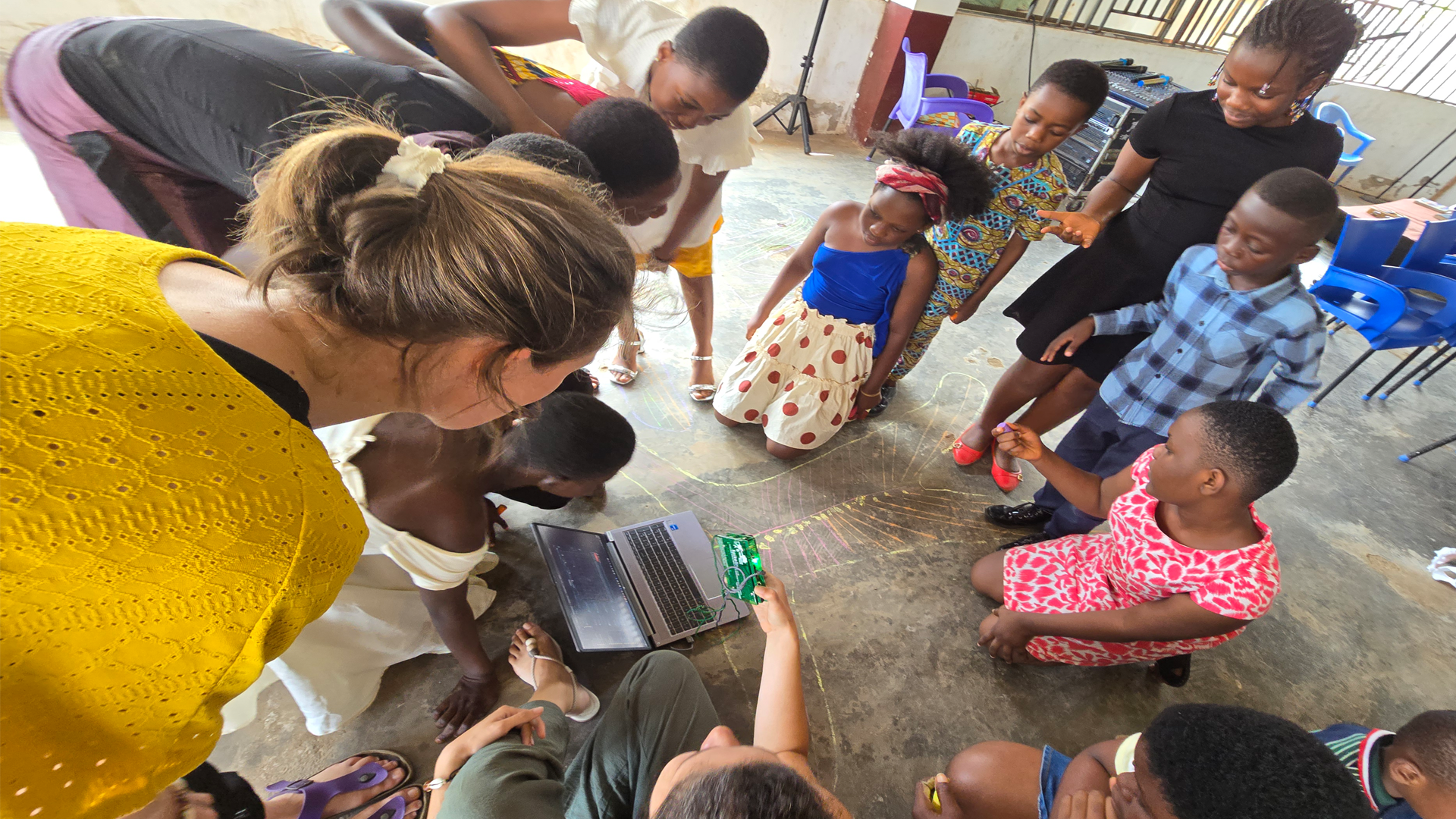
Spikeling for kids !
Yound students Spikeling workshop in Ghana for outreach about the nervous system, with VIB CBD researchers.
Spikeling dedicated GUI
A dedicated cross-platform desktop GUI supports real-time plotting, experiment control, and recording/export to standard formats—enabling teaching modules that extend beyond neurophysiology into protocol design, data collection, analysis pipelines, and model-based reasoning.
Spikeling is designed to extend practical teaching beyond “watching spikes” into the full experimental workflow: recording, quality control, basic quantification, and export for reproducible analysis. This is particularly valuable in neuroscience curricula where students may have limited exposure to programming and data pipelines, yet are expected to interpret real experimental data.
The GUI also provides a lightweight, built-in analysis layer that helps students validate recordings and immediately compute core measures such as spike detection and trial-averaged responses. This supports in-class demonstrations, rapid iteration during labs, and structured home assignments.
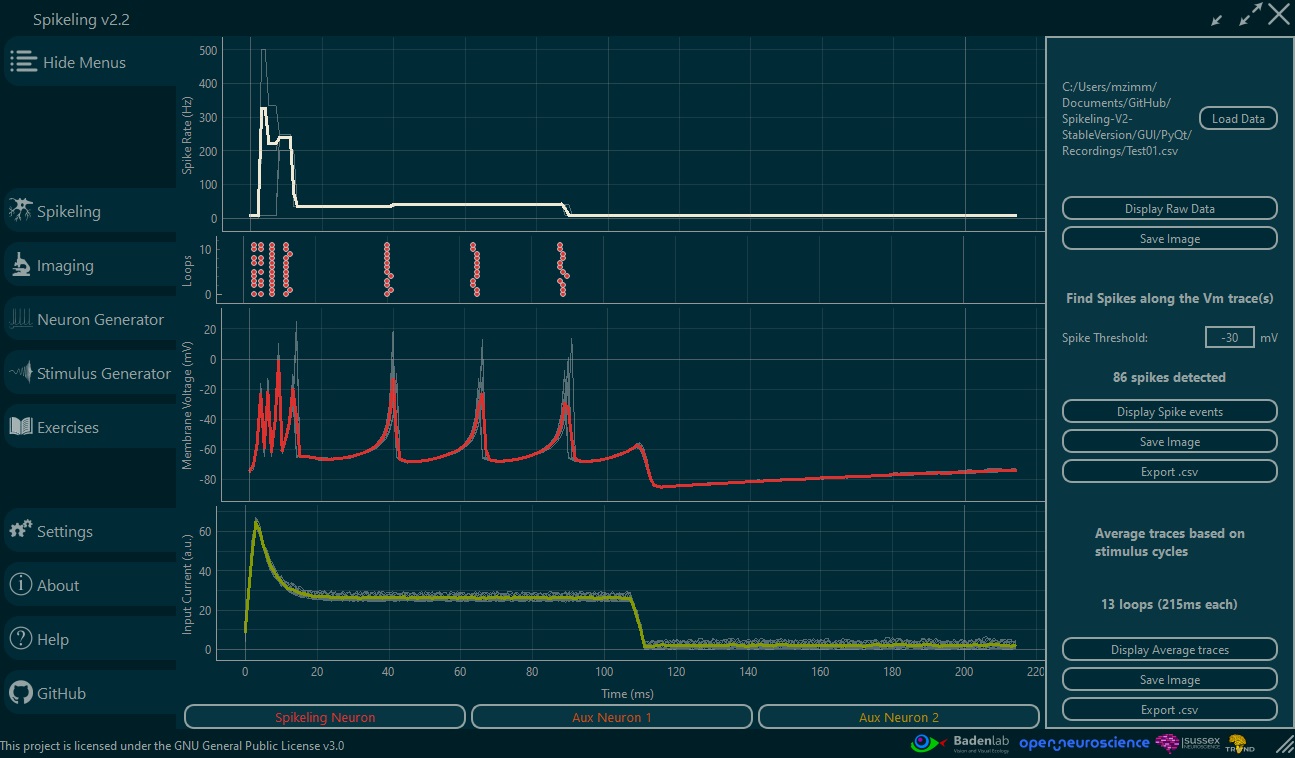
Spikeling GUI - Data Analysis example
Averaged recording showing the spike rate (white), the raster plot (red dots), the voltage membrane (red) and the input current (green)
Source Files and Documentation
Spikeling is an open-source hardware and software project developed to make hands-on neurophysiology teaching accessible and reproducible. All design files, firmware, and the desktop application are publicly available in our repository, along with documentation and classroom-ready workflows.
Licensing (open by design)
-
Software & firmware: released under GPL-3.0-or-later.
-
Hardware design files: released under CERN-OHL-S-2.0.
This ensures the project remains free to use, study, modify, and redistribute—while preserving attribution and open distribution of improvements.
Join the community
We actively welcome contributions from educators, students, engineers, and makers: documentation improvements, bug reports, feature requests, translations, new experiments, and hardware revisions.
If you are deploying Spikeling in a course or workshop, we would also love to hear your feedback and showcase your use case.
The Spikeling Team
Follow us on Social Media for Spikeling Updates !
During the Computational Neuroscience and Machine Learning Basics our team used #opensource education tools #Spikeling -an implementation of a spiking neuron and #Lu.i -a neuron simulation PCB
— TReND in Africa (@TReNDinAfrica) June 20, 2023
to help students understand the basis of neuron function.#OpenScience #openhardware pic.twitter.com/b6CnzYyltn
Day 3 of OpenNeuroscience course @SBUpsych, funded by @dana_fdn, with @chagas_am from @TReNDinAfrica and openneuroscience. Participants designing their own projects: spinal cords, rat skulls, T mazes, Purkinje cells @SreyashiCUNY @poon_lab pic.twitter.com/Zd1FcdO9TN
— Turhan Canli (@TurhanCanli) January 14, 2023
Our students kicked off the week with Spikeling from @OpenSourceNeuro, seeing neurons fire live and making theory real. Then they explored the Allen Institute Brain Atlas, preparing for upcoming projects.
— TReND in Africa (@TReNDinAfrica) July 10, 2025
Thanks to @OpenSourceNeuro & @AllenInstitute for supporting #TReNDCaMinA pic.twitter.com/6T9ewd3YA1
Day 1-5 📸
— TReND-CaMinA (@trend_camina) July 13, 2024
Our students are continuesly introduced to #openscience concepts & they are loving it!
👇they are using #Spikeling by @OpenSourceNeuro and #Lu.i by @sbillaudelle @NeuroTMA @BrainScaleS to understand neuron spiking & working with #opendata from the @AllenInstitute
/n pic.twitter.com/0YTbctb17m
Last June we were at #FENS2024 in Vienna demonstrating open science tools for neuroscience research and education.
— Open Source Neuro (@OpenSourceNeuro) July 6, 2024
Our warm thanks to all that came to our stand and exchanged with us.
Stay tuned for more open science content coming very soon. pic.twitter.com/ia4QnXW1yy
Our students kicked off the week with Spikeling from @opensourceneuro.bsky.social, seeing neurons fire live and making theory real. Then they explored @alleninstitute.org open neural data, preparing for upcoming projects.
— TReND-CaMinA (@trendcamina.bsky.social) 10 July 2025 at 19:55
[image or embed]
Sooo many spikelings 🙂 @MJY_Zimmermann https://t.co/ArHOsVyoDE
— Tom Baden (@NeuroFishh) January 14, 2023
@MJY_Zimmermann introducing Spikeling- an #opensource implementation of a spiking neuron for neuroscience teaching- to our participants at the Advanced Neuroscience School in #CapeTown.
— TReND in Africa (@TReNDinAfrica) December 6, 2022
@ibroSecretariat #OpenScience #openhardware @PLOSBiology pic.twitter.com/wvm9nK0LYL
How do you know participants really engaged with the course content and the lecturers? 👇👇😄
— TReND in Africa (@TReNDinAfrica) December 10, 2022
@ibroSecretariat advanced #OpenScience and #Neuroscience course pic.twitter.com/8vNme67dtf
1) Spikeling: build your very own in silico neuron! Fresh out @PLOSBiology ! https://t.co/ouNLmXQjVm. £25 a pop, #opensource & exercises for teaching! @MMaravall @neonsynapse @MJY_Zimmermann @Philipp_Bartel @DoriekeMG @teulerlab @SussexNeuro @SussexLifeSci @TReNDinAfrica pic.twitter.com/NCMPWWGXiQ
— Tom Baden (@NeuroFishh) November 8, 2018
Spikeling - a £25 build-your-own #OpenSource in silico spiking neuron that mimics a wide range of neuronal behaviors for classroom education & public neuroscience outreach from @NeuroFishh &co #PLOSBiology #OpenScience https://t.co/LGy62SguNR pic.twitter.com/oyBZ72jrSc
— PLOS Biology (@PLOSBiology) October 29, 2018
Cool demo of the Spikeling from @NeuroFishh's lab by @MJY_Zimmermann: a low-cost #openhardware implementation of a spiking neuron for neuroscience teaching and outreach. https://t.co/SuLElZaTmo #FENS2018 #openscience pic.twitter.com/mW0M21M34R
— Jenny Molloy (@jenny_molloy) July 7, 2018